
Tennis Coaching
Keep the hitting elbow in front to tighten your forehand volley
Keep the hitting elbow in front on a forehand volley to build a stable platform and sharper control.

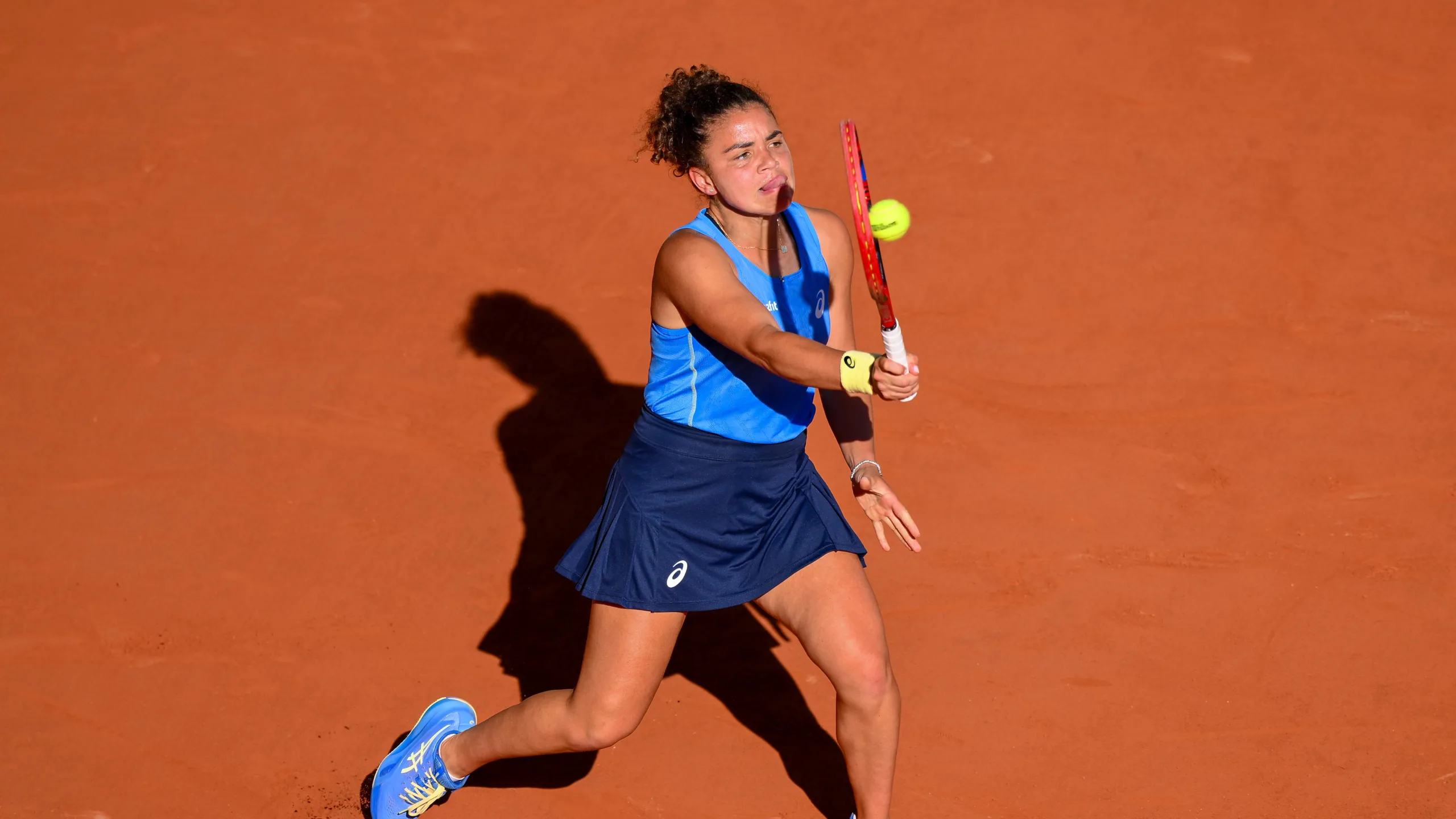
For such a short stroke, the volley rewards simplicity. A steady racquet face, a simplified technique and precise targeting are the core of reliable net play. Even a small lapse in detail, however, can produce mishits, unforced errors and shaky confidence at the net.
An often overlooked detail is the position of the hitting elbow. On the forehand volley the elbow has more freedom to roam, and when it is pinned to the side or drifts behind the body the stroke loses structure, timing and reliability. If the elbow is stapled to your ribs, the hitting wrist is forced to snap forward to produce a swing. The tip of the frame leads the way, creating an unstable racquet face and unpredictable volleys.
Keeping the elbow in front at a proper distance builds a strong, balanced hitting platform that promotes cleaner contact and improved command. This positioning helps maintain a firm, laid-back wrist and allows you to put underspin on the ball to control the shot. It also improves your ability to absorb or redirect pace from your opponent’s shot with an economy of motion.
When the elbow wanders behind the body, the short volley stroke often becomes too much of a swing. The contact point can move too far back, which results in late hits. You are more likely to “swat” at the ball instead of directing it cleanly, compromising direction, depth and consistency.
The hitting arm straightens through contact while the wrist remains in a laid-back position.
Follow these steps to make proper use of the hitting elbow on the forehand volley:

ATP Player News Tennis Coaching
Ferrero shifts into golf with Angel Ayora as Alcaraz pursues a Career Grand Slam
Ferrero ends his partnership with Alcaraz and joins Angel Ayora to work on the mental side. He stays

Juan Carlos Ferrero has moved from the highest levels of tennis coaching into a new role in golf while remaining committed to the academy that bears his name. The 45-year-old announced Sunday that he is joining Angel Ayora’s team and will focus on the mental side of the sport.
After his long partnership with Carlos Alcaraz ended in December, Ferrero’s seven-plus years as coach were widely credited for guiding Alcaraz to the ATP No. 1 ranking and helping him collect two titles apiece at Wimbledon, Roland Garros and the US Open. Alcaraz is now pursuing a Career Grand Slam at the Australian Open and has advanced to the quarterfinals without Ferrero at his side.
Ferrero described the new working relationship in his own words: “We’ll be working together on the mental side of performance and professional development,” and added, “We’ve already started, highly motivated and looking forward to continuing this journey.”
The former world No. 1 stressed that the shift to golf does not mean abandoning his tennis commitments. He will continue his involvement with the Ferrero Tennis Academy in Villena, the training centre originally founded in 1990 by Antonio Martínez Cascales and later rebranded to honor the coach’s role in producing a Roland Garros champion. The facility includes the Rural Ferrero Hotel and several padel courts among its offerings.
Ferrero framed golf as a new challenge that still relies heavily on the psychological side of competition. “Tennis is my life, and I’ll continue giving my all at the Academy and on the circuit. However, golf also excites me—it’s an individual sport where the mental aspect plays a crucial role,” he explained. “I’m delighted to be able to contribute my experience and support Angel’s growth on the circuit.”
The short-term picture finds Ferrero balancing his academy responsibilities with this fresh role supporting Ayora’s professional development. © Instagram @juankiferri
Analytics & Stats Player News Tennis Coaching
Gauff leans into topspin and pace with a simple mantra: trust and accelerate
Gauff trusts more racquet-head speed, using topspin and pace to improve her serve and forehand more.
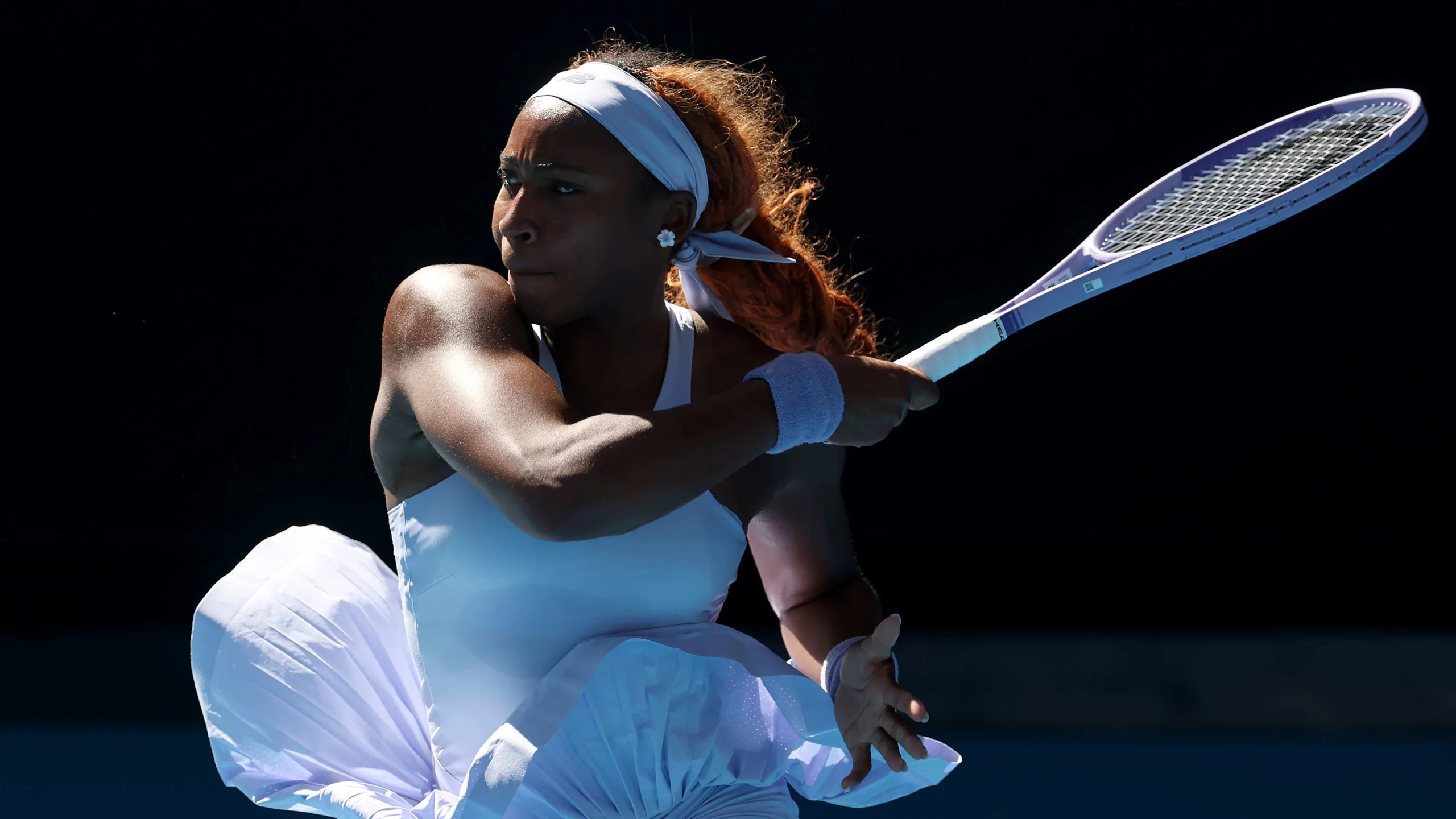
For nearly the first hour of her second-round match on Friday, Coco Gauff watched Hailey Baptiste play the way Gauff has been trying to play. Baptiste, a longtime junior friend ranked 67 spots behind Gauff and with 11 fewer titles, captured the first set 6-3 by snapping serves into the corners and following them with inside-out forehands struck with pace and heavy topspin.
“She was dictating a lot, especially on her forehand side,” Gauff said of that opening set. “I was just trying my best to neutralize that.”
Gauff’s path back was not to outgun Baptiste in raw power. “I thought I served better in the second and third set, got more first serves in,” she said, and, “Overall I think just trying to put her on the back foot and not me being on the back foot.” She lost the opening set but answered with a 6-0 second set and closed 3-6, 6-0, 6-3.
Gauff entered the match less smooth in certain areas: she hit her serve five m.p.h. slower, produced 12 fewer winners and committed six more double faults than her opponent. Still, she turned it by running, cutting her unforced errors to 22 against Baptiste’s 38, attacking with her backhand and winning 83 percent of her first-serve points. At a tense 30-30 late in the third, she finished a rally with an inside-out forehand winner.
She accepts that the serve and forehand will be inspected and insists progress is gradual. “I think at this point I have the right motion,” Gauff said after beating Baptiste. “I feel like I’m working on the right things. Now it’s just trying to, I guess, erase old demons and actually do it.” “There was moments today I was definitely nervous, and I felt like I’m getting better with each match dealing with that on those pressure moments.”
As one legendary player put it: “Racquet-head speed is your friend.” Gauff has rediscovered that topspin and faster racquet-head speed can coexist. “For me, I just felt like I had to hit flatter to hit bigger,” she says. “I’ve always thought for some reason in my head that hitting shape was more defensive, and I realized that you can be really offensive and aggressive hitting with shape,” says Gauff, using “shape” to mean spin and arc. The biggest change for Gauff in 2026, she says, is “just trusting and accelerating.” She will next face Grand Slam finalist Karolina Muchova, with the potential third-round meeting against Mirra Andreeva awaiting the winner.
Player News Tennis Coaching United Cup
Inside Episode 1 of The Big T: Coaching fallout, United Cup and early-season storylines
A strong debut for The Big T focused on Alcaraz/Ferrero split, United Cup and early matches.
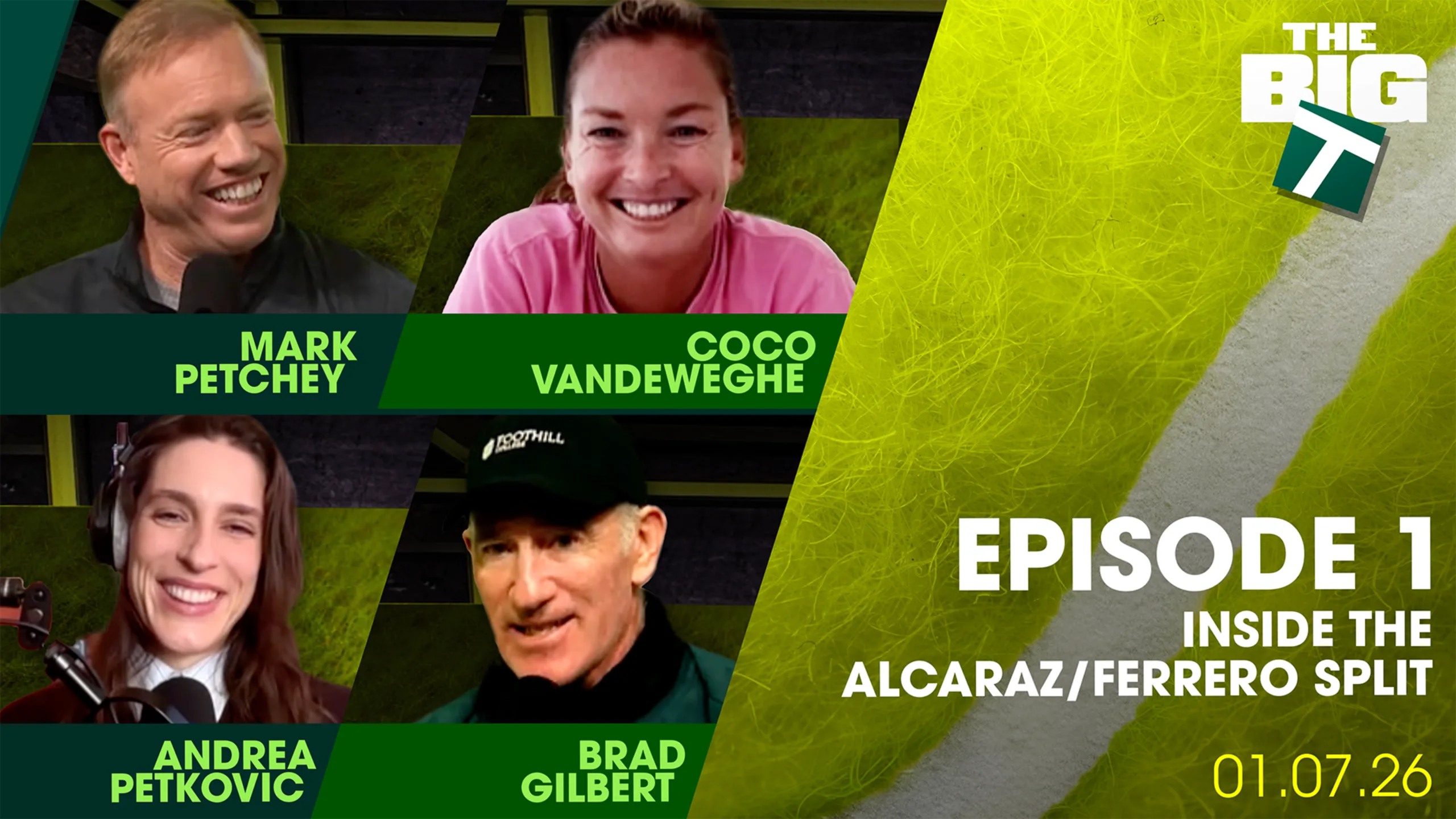
The Big T launched with a forthright premiere that dug into coaching dynamics, mixed-team competition and early-season matches. Hosts Brad Gilbert, Mark Petchey and Andrea Petkovic set a direct tone, and Coco Vandeweghe joined the conversation briefly as part of the cast.
A central thread was the surprise split between world No. 1 Carlos Alcaraz and longtime coach Juan Carlos Ferrero. “This onion has started to peel a little bit further,” Gilbert noted about the shock split of world No. 1 Carlos Alcaraz and longtime coach Juan Carlos Ferrero. Each panelist drew on personal experience to assess emotional and practical consequences, and Petkovic observed the event’s reach: “Everybody know where they were when they found out,” said Petkovic. Petchey summed up the immediate human cost bluntly: “ it f—ing hurts.”
The episode also touched on personal milestones across the tour: Venus Williams and Casper Ruud recently married, and Coco Vandeweghe announced an engagement. Vandeweghe checked in with the hosts before a flight to share the news.
Petkovic praised the mixed-team format of the United Cup, calling it a unique event because of its combined-gender competition. “If you had everyone in one place, this could be the greatest tennis event outside of the majors,” the German declared, noting a man and a woman can share a court and benefit each other.
The panel reviewed singles matches that revealed early-season form, including Taylor Fritz vs. Jaume Munar and Coco Gauff vs. Jessica Bouzas Maneiro, pointing listeners to full replays and highlights available on the show’s platform.
Gilbert dedicated time to the Sinner-Alcaraz rivalry and predicted repercussions from the coaching change. “More than anything, advantage Sinner,” says Gilbert. “If you put Andre and Novak Djokovic in a blender, you come up with Sinner.” Petchey still praised Alcaraz’s craft as “the great tennis mixologist,” while the hosts set expectations for how the rivalry could develop in 2026.
The Big T will return weekly with new episodes every Wednesday.

From Fans to Contenders: Iva Jovic and Learner Tien’s Indian Wells Homecoming

Sabalenka in Gucci: front row at Gucci’s Fall 2026 show ahead of BNP Paribas Open

Gauff vs. Pegula: Who Arrives in Better Shape for Indian Wells 2026?

Alcaraz Confronts On‑court Microphones During US Open Practice Ahead of Opelka Match

Raducanu Arrives at US Open With Momentum After Strong Hard‑Court Swing

Cervara: Ending an eight‑year partnership with Medvedev was necessary to change the energy
-
 ATPAustralian OpenGrand Slam2 months ago
Australian Open announces record A$111.5 million prize pool for 2026
-
 ATPUnited CupWTA2 months ago
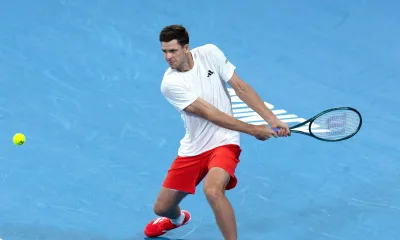
Hurkacz edges Zverev in straight sets in United Cup return
-
 ATPPlayer NewsWTA2 months ago
Vesnina rejects claim that podcast aired unapproved Kudermetova anecdote about Rune