
ATP Australian Open Grand Slam
Wawrinka converts nerves into momentum in opening Australian Open victory
At 40, Wawrinka turned pre-match nerves into force, rallying to beat Djere in a four-set opener. Now

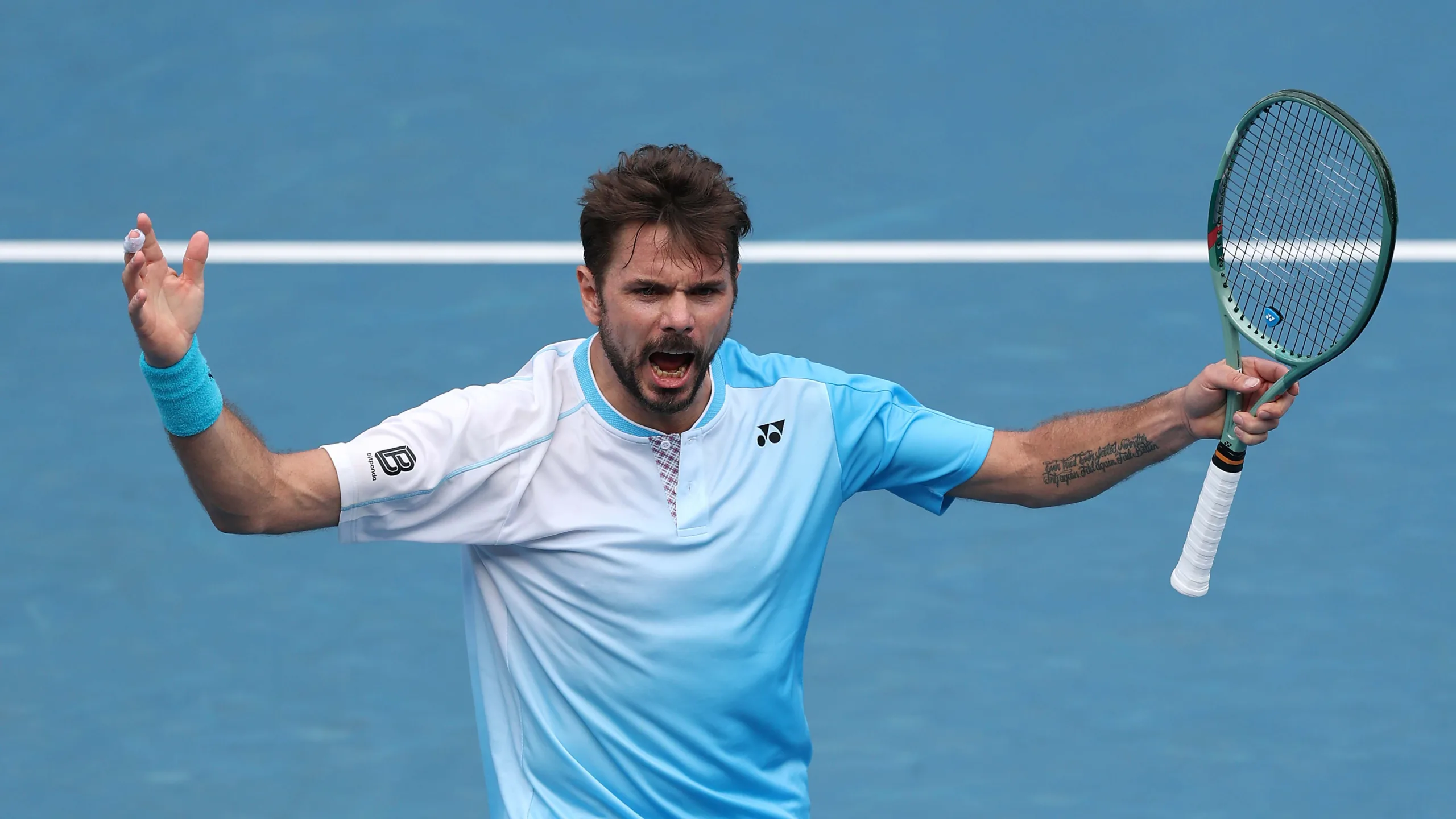
Stan Wawrinka used the wild card handed to him for his farewell season to turn familiar pre-match nerves into a complete performance in the Australian Open opener. The 40-year-old, the 2014 champion, came from a set down to defeat Laslo Djere 5-7, 6-3, 6-4, 7-6 (4) in a match that lasted three hours and 23 minutes at Kia Arena.
Wawrinka arrived at Melbourne Park after a demanding United Cup, where he went toe-to-toe with Top 50 opponents and a returning-from-injury Hubert Hurkacz across a five-match stretch while helping Switzerland to a runner-up finish to Poland. In all five United Cup matches he had played from behind, including a victory over 27th-ranked Arthur Rinderknech.
“I’ve been working really hard to stay in shape, to push myself. I think also the week in United Cup helped me a lot because I played over three hours back-to-back, plus a lot of tennis on the court, high level,” Wawrinka said in his press conference. “It got me a lot of confidence into what I’m able to do.”
The three-time major winner celebrated his first win at the Happy Slam in five years and his first Grand Slam match victory since 2024 Wimbledon. He served 14 aces against Djere and won 75 percent of his total points on serve. Wawrinka is ranked No. 139 coming into this event and now holds 159 major match wins.
Wawrinka acknowledged the limits that come with age while stressing the importance of discipline and commitment. “That’s always been positive for me. That means I really care. That means I really want to do well. I’m really pushing myself,” he said. “That’s when you need to be really disciplined with yourself, with your brain, with what you have to do during the match.” He added: “I know I’m not as good as I was before. I know I’m not physical and tennis-wise as I was before. That’s normal,” and, “I’m getting old. But I’m still happy with what I’m doing, always trying to push my own limit, always trying to be better.”





ATP Grand Slam Wimbledon
Wimbledon to introduce video review on six courts for 2026
Wimbledon will introduce video review on six courts in 2026 and add visual out and fault signs. Also
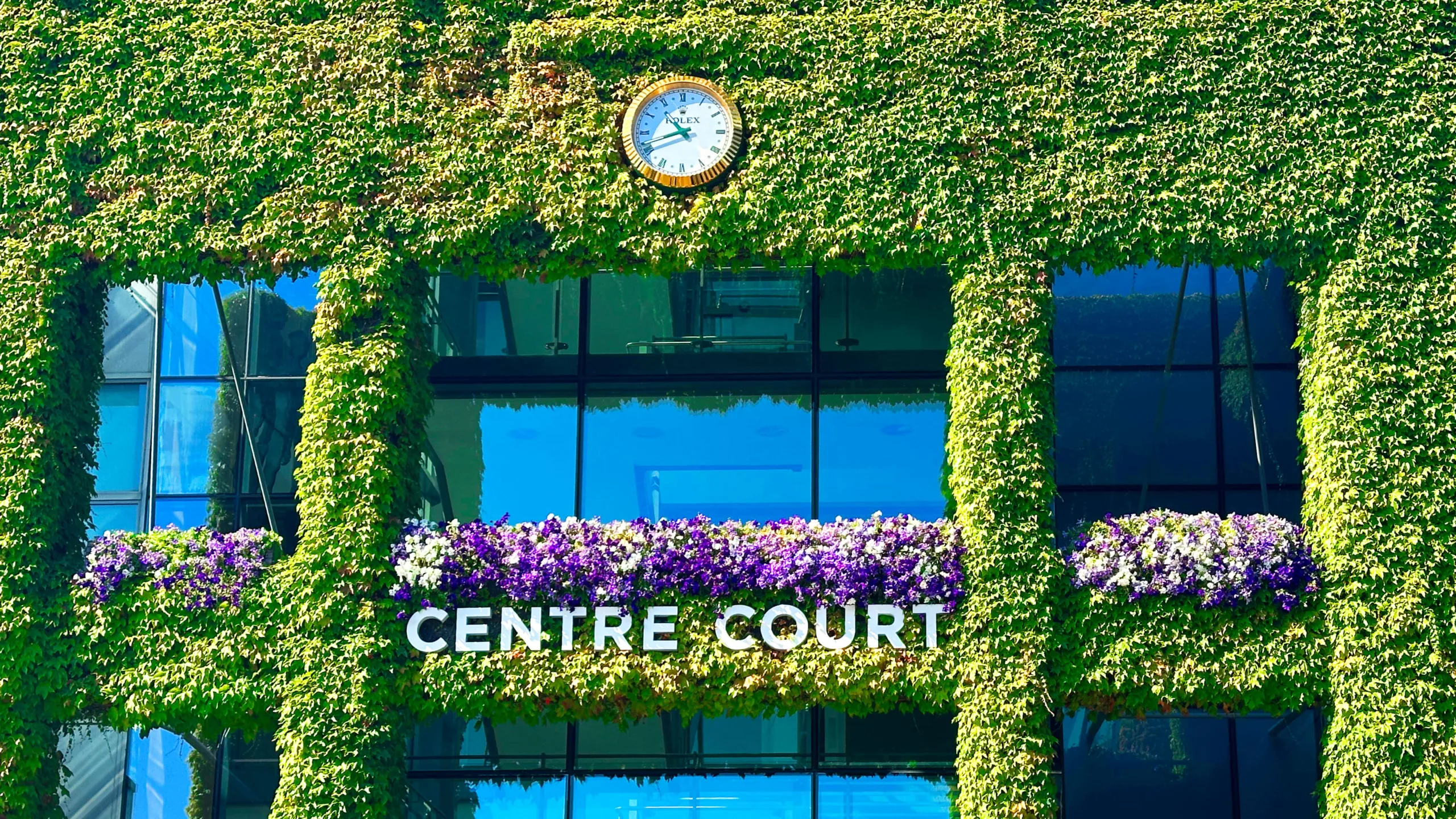
The All England Club confirmed that video review will be available on six courts at Wimbledon in 2026. The announcement came on Saturday during a media briefing 100 days from the start of the event.
Review capability will be installed on Centre Court, No. 1 Court and four additional show courts: No. 2 Court, No. 3 Court, Court 12 and Court 18. Players will have unlimited opportunities to challenge specific chair-umpire decisions. The system will allow reviews of whether a ball bounced touched, whether a player touched the net, and other rulings either on a point-ending call when a player immediately stops play, or immediately after the completion of a point in the case of hindrance.
Video review is distinct from electronic line-calling, which Wimbledon adopted in 2025 to replace line umpires. That change proved controversial at times; the tournament later blamed “operator error” when a ball hit well long by Brit Sonay Kartal was not called against Anastasia Pavlyuchenkova, and another point required a replay because of a system failure during a quarterfinal match between Taylor Fritz and Karen Khachanov.
The technology first appeared at a Grand Slam at the 2023 US Open and was used at the Australian Open in 2025. The ATP Tour rolled out video review at all Masters 1000 events last year after deploying it at the NextGen ATP Finals since 2018 and at the year-end ATP Finals since 2020.
In addition to introducing video review on six courts, Wimbledon will add a visual indication on scoreboards when a ball is out or a serve is a fault, supplementing the audible call.
1000 ATP Miami Open
Miami Open Preview: Pegula vs. Rybakina and two close quarterfinal tests
Pegula and Rybakina meet again in Miami; we also assess Paul-Fils and Lehecka-Landaluce. Read picks!
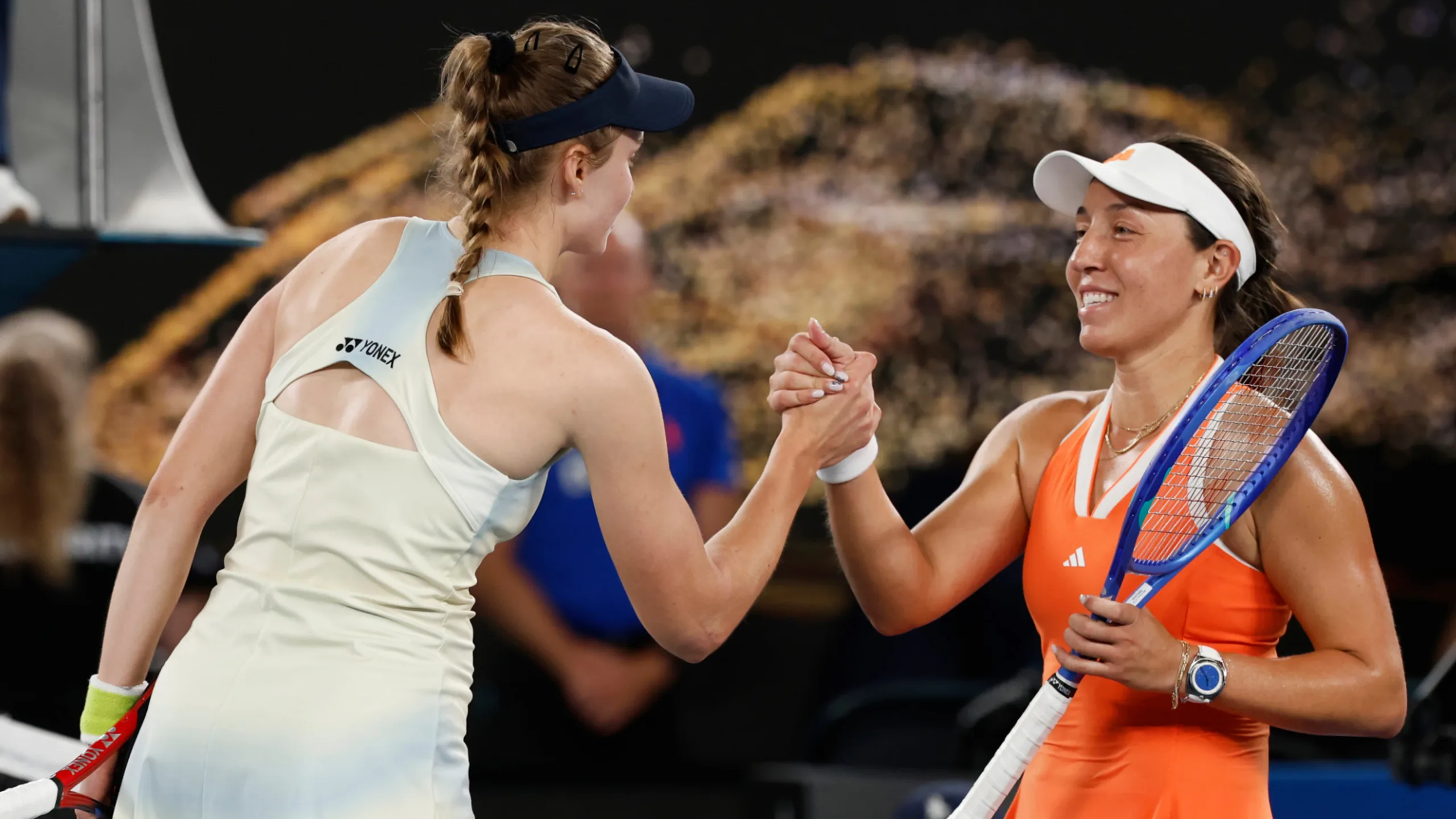
The Miami Open brings another chapter in the recent rivalry between Elena Rybakina and Jessica Pegula. The pair have met at the Billie Jean King Cup, the WTA Finals, the Australian Open, Indian Wells and now Miami, with Rybakina holding a 4-0 edge in those meetings. Pegula has challenged her, taking sets and pushing tiebreaks, but Rybakina’s serve and court craft have remained decisive.
Both women arrive in Miami unbeaten in three matches and comfortable on the courts. Rybakina reached the final here in 2023 and 2024; Pegula made the final in 2025. One variable that could matter is the start time: the match is scheduled for 1:00 P.M., when conditions are expected to be warmer and quicker. Pegula prefers quick conditions and has not had them in recent meetings with Rybakina, which came at night in Melbourne and on the slower Indian Wells courts. That switch could help the American and add a few miles per hour to her game. Winner: Pegula
The bottom half of the ATP draw has produced intriguing quarterfinals. Martin Landaluce, a 20-year-old product of the Rafa Nadal Academy and the 2022 US Open boys champion, has been one of Miami’s breakthrough players. Counting qualifiers, he has won six matches here, three in three sets, and in his last match he recovered from a 6-2 first-set deficit to beat Sebastian Korda and saved a match point en route.
Landaluce meets Jiri Lehecka for the first time. Both play with efficient, easy power; Landaluce has momentum, while Lehecka, the 22nd-ranked veteran, has just beaten Taylor Fritz in his best match of the season. Fuel and composure are the deciding factors. Winner: Lehecka
Tommy Paul and Arthur Fils present another difficult call. The players are close in the rankings, with Paul 23rd and Fils 31st. Both are athletic, strike the ball well and have shown solid form this season — Paul at 14-6 and Fils 12-4 as he returns from a lengthy layoff. In Miami each survived at least one three-set match. Paul will have a home crowd and the evening conditions, while Fils is still rebuilding his rhythm. This one is a coin flip.
ATP Masters Miami Open
Nadal urges calm after Alcaraz’s Miami Open exit
Nadal: Alcaraz’s Miami loss is not cause for alarm after his Australian Open and Doha form in 2026.
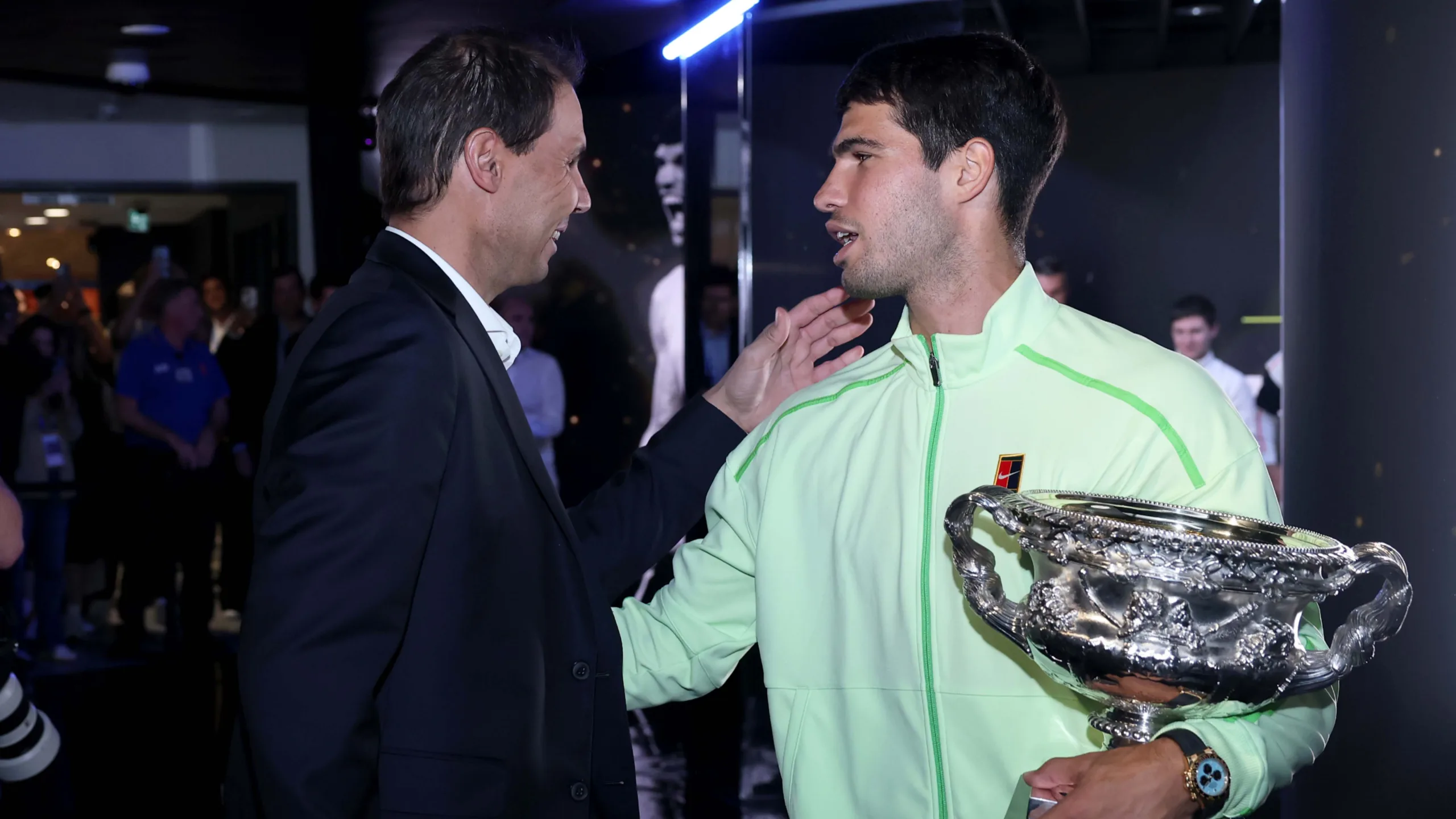
Carlos Alcaraz’s third-round loss to Sebastian Korda at the Miami Open prompted questions about the Spaniard’s form, but Rafael Nadal dismissed the idea that the result signals a crisis.
The 22-year-old bowed out in Miami for the second year running. His 2026 record stands at 17–2, yet Nadal told reporters in Madrid on Tuesday that criticism is exaggerated. “I mean, when he’s just come off winning the Australian Open, he’s won seven Grand Slams, he’s No. 1 in the world… So, what? Is he supposed to win all of the matches of the year?” Nadal told press. “That’s never going to happen. So there’s your answer.”
Alcaraz’s Sunshine Swing had mixed results. He reached the semifinals in Indian Wells before being upset by No. 11 seed Daniil Medvedev. In Miami he won one match, a high-profile victory over Joao Fonseca, then fell in three sets to No. 32 Sebastian Korda, a result described as the American’s biggest career win.
Nadal argued that a title-less March should not erase Alcaraz’s achievements earlier in the season. The Spaniard captured the Australian Open, becoming the youngest man to complete the Career Grand Slam, won an ATP 500 title in Doha, retained the world No. 1 ranking and extended a 16-match unbeaten run that ended at Indian Wells. “Are we really going to worry about two defeats? I don’t think so,” Nadal said. “That doesn’t make sense, and we shouldn’t demand more from him.”
Nadal, who received an honorary doctorate for excellence in sport from the Universidad Politécnica de Madrid, reflected on the pressures placed on young players in Spain and urged perspective. “I think what we all have to do is just congratulate Carlos and thank him for everything that he’s accomplishing,” he said. “In the end, he’s bringing a number of achievements to Spanish sport that, maybe 25 or 30 years ago, we wouldn’t have imagined…
“Maybe we’ve all gotten too used to it. But I’ve never lost perspective on how difficult the things are that Carlos is doing—or any athlete from Spain, or any other country.”

Wimbledon to introduce video review on six courts for 2026

Miami Open Preview: Pegula vs. Rybakina and two close quarterfinal tests

Nadal urges calm after Alcaraz’s Miami Open exit

Alcaraz Confronts On‑court Microphones During US Open Practice Ahead of Opelka Match

Raducanu Arrives at US Open With Momentum After Strong Hard‑Court Swing

Cervara: Ending an eight‑year partnership with Medvedev was necessary to change the energy
-
 ATPAustralian OpenGrand Slam2 months ago
Medvedev says he will not underestimate Learner Tien as their Australian Open rivalry resumes
-
 ATPAustralian OpenGrand Slam2 months ago
Offseason Focus: How Eliot Spizzirri’s Boca Raton block set up his Australian Open breakthrough
-
 ATPAustralian OpenGrand Slam2 months ago
Jakub Mensik withdraws with abdominal injury, Novak Djokovic advances at Australian Open