
ATP Australian Open Grand Slam
Alcaraz overwhelms Paul in straight sets to reach Australian Open quarterfinals
Alcaraz beat Paul 7-6(6), 6-4, 7-5 to reach the Australian Open quarterfinals in straight sets. 2026

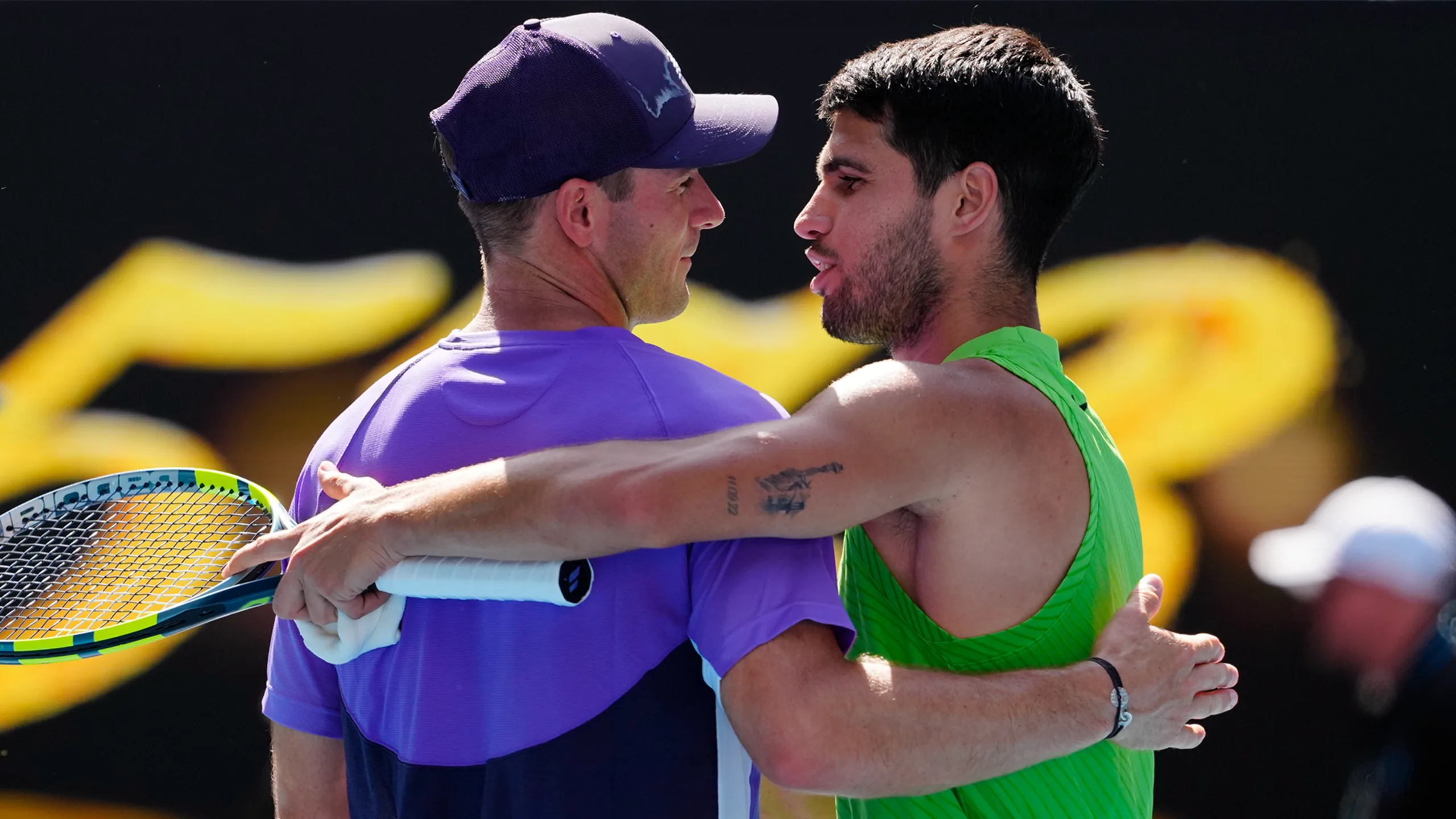
World No. 1 Carlos Alcaraz beat Tommy Paul 7-6 (6), 6-4, 7-5 to advance to the Australian Open quarterfinals. Paul broke in the opening game, but the top-seeded Spaniard steadily tightened his control and left the in-form American on the defensive.
“I have to accept the tough moments that is gonna be in the match,” he said on Friday . “You know, from that, just move on, and I’m trying to feel comfortable, you know, in those rallies, in those tough moments.” Alcaraz combined that mindset with efficient point construction, denying Paul time to impose his own patterns.
“He makes you feel like you have no time,” the No. 19 seed explained. “He rushes you.
“I hit my forehand terribly today, and he saw that early. He was trying to get in that forehand-to-forehand rally, and he did it much better than I did. That’s what it felt like. It felt like he got all the patterns he wanted, and I was having a tough time getting into the patterns that I wanted.”
Paul, who beat Alcaraz in 2022 and 2023, has kept their matches close, but the world No. 1 has now won the last five meetings between them. “You know you’re going to have fun, at least,” sighed Paul, who shut down his season after the US Open last summer. “When we have points like that and the crowd loves it, we love it. You know that you’re going to have fun points. You know that you’re going to, like, have points you both play great tennis.
“I wish we had more of them today, honestly. Obviously for me that means that I’m coming up with shots and being a shot-maker. Obviously we’ve all seen that he does that. I wish there were more. That is the fun part about playing Carlos, though.”
The first-set tiebreak was the match’s closest moment, and play was halted for nearly 15 minutes to assist a sick fan leaving the arena. Paul grabbed a late mini-break in the Sudden Death but could not hold it, and Alcaraz closed out the set before taking the next two.
“Something that I was working on is to maintain the focus in the whole match, which I did it today, playing such great tennis since the beginning until the end of the match,” smiled Alcaraz in a truly absurd outfit—a zebra printed shirt and matching cape. “So, for me, it was really, really important more than saving energy, because I just have plenty of!”
“I’m overall leaving Australia pretty happy with where my body is at and where my game is at, for not playing for a while,” said Paul, who aims to get back into the Top 10. “I feel like I jumped right back into it pretty quick. So overall leaving happy.”
Alcaraz, the reigning Roland Garros and US Open champion, will face one of two Alexanders in the quarterfinals: No. 6 seed De Minaur or No. 10 seed Bublik. “I have to control the things that I can control,” said Alcaraz, who leads De Minaur 5-0 in their head-to-head but has never played Bublik before. “You know, if it is going to be really, really hot on Tuesday and the roof is going to be closed, I gotta to be accepted that and just trying to play my best tennis on indoor.



ATP Masters Miami Open
Medvedev weathers travel woes to rally past Rei Sakamoto at Miami Open
Medvedev overcame travel delays and a lost bag to rally past Rei Sakamoto on Stadium Court in Miami.
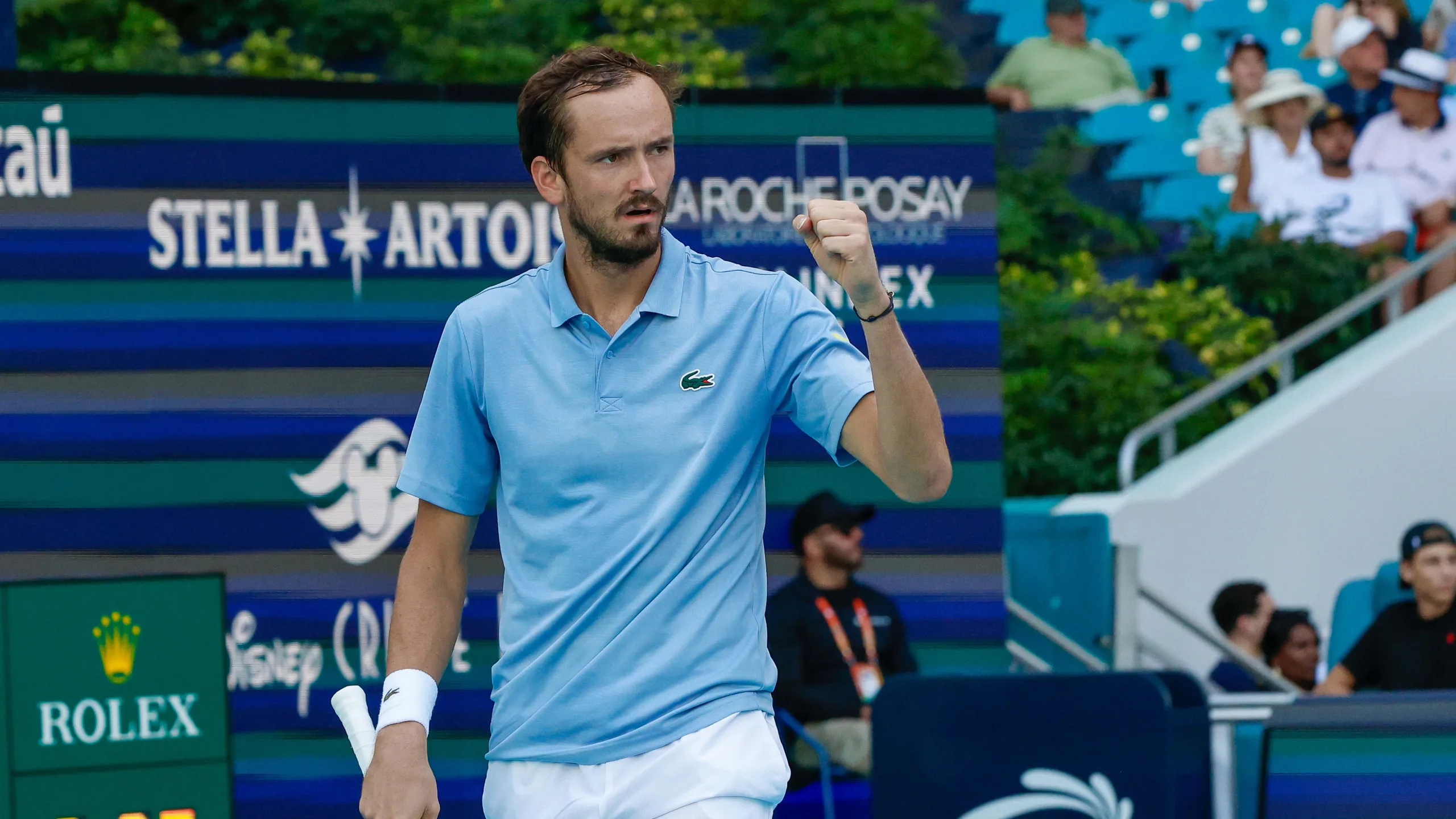
Daniil Medvedev endured travel setbacks before his Miami Open match but ultimately produced a steady recovery to defeat Rei Sakamoto, 6-7 (10), 6-3, 6-1. The former world No. 1 arrived at Hard Rock Stadium after a delayed luggage arrival and used patience and consistency to turn a precarious start into a decisive finish.
Medvedev had already faced disruption earlier in the Sunshine Swing, nearly missing the BNP Paribas Open after being stranded in Dubai. Those off-court headaches contrasted with a strong run on court: he came into Miami off a runner-up finish in Indian Wells. That event, usually noted for slow conditions that can frustrate Medvedev, proved favorable to him this year — he thrived in the California desert and even snapped Carlos Alcaraz’s 16-match winning streak en route to the championship match.
The slow conditions in Miami initially played into the hands of his opponent. Sakamoto, a 19-year-old IMG Academy alum, claimed a 22-point tiebreaker to take the first set and had Medvedev on the ropes. But Medvedev, seeded No. 9, steadied his game on Stadium Court and found a rhythm as the match progressed.
“It’s completely different conditions [here],” Medvedev said on court after the match. “It’s always been. Usually, I feel like it’s kind of quicker in Miami—not too much, but a bit. This year, it’s slower because Indian Wells was fast, so it feels much slower. The serve can still work but in the points it’s much slower. I was losing the rhythm and I was just not ready for the ball to react the way it was reacting.”
Medvedev said he sensed a drop in his opponent’s energy as the match lengthened. “I’m super happy I managed to build up moment and also the tiredness in him because he’s still a junior in a way,” he said after the match. “It’s not easy for him. He’s going to learn from this. So, I’m happy I managed to put it up and win the match.”
ATP Masters Miami Open
Tommy Paul’s Camo, Collabs and the Quiet Work of Returning to Form
Tommy Paul blends outdoor life, a New Balance collab and a patient return to top-level tennis. Now..
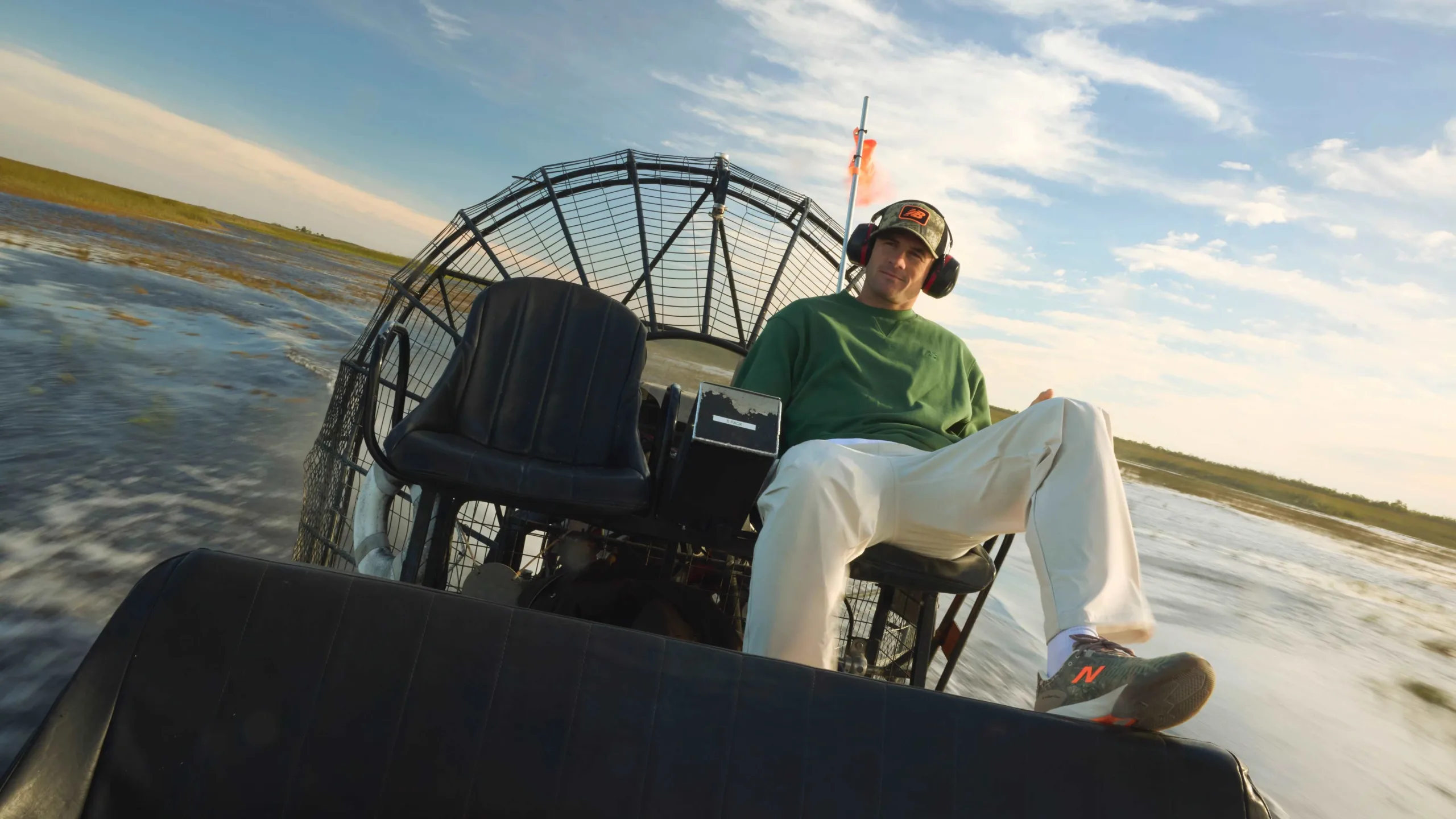
Tommy Paul has spent the early weeks of the season balancing a clear on-court mission with a life built around the outdoors and a pair of new shoes. “Being an outdoor kind of guy, I wear camo every single week if not every day,” Paul said, introducing the CT-Rally v2 “Outdoor Court” edition, his first colorway collaboration with New Balance.
“I think it’s the best-looking shoe on the market in tennis,” he said. Paul described New Balance as a partner that allows him style and expression. “They do what they want, and they do it well,” he told me. “They want to give me a platform to express myself and what I’m about.”
The apparel and equipment storyline sits alongside other outdoor projects. “It’s freedom, it’s meditation, but it’s also an escape,” Paul said of fishing and hunting. “Growing up in North Carolina, we’d be fishing every weekend I wasn’t playing in the summer. It was something I absolutely loved doing. I knew that, when I got older, I’d have that kind living where you go out there fishing, harvesting, and eating. It’s even cooler now because I’m in Florida and I can do it all year round.”
Paul also unveiled a partnership with Yellowfin Yachts, a new boat he enjoyed testing and joked about with peers. “That is so funny,” he said when I called it a “yacht.” He plans to travel in it, with the Bahamas on his short list.
The on-court narrative is straightforward. The 28-year-old former No. 8 halted his 2025 season after the US Open because of a foot injury that surfaced at Wimbledon, and he returned ranked No. 23. He pushed Carlos Alcaraz at the Australian Open, reached a final in Delray Beach and cites Davis Cup qualifying alongside Ethan Quinn and Emilio Nava as a season highlight. “I’m really just focused on right now, getting everything sorted and everything locked in to play my best tennis. If I’m playing my best tennis, everything will work itself out. I’m not really too focused on a No. 3 spot, Top 5 or Top 10 spot. I’m more focused getting to a point where I can play my brand of tennis consistently, without too much lapse. That’s what separates the top guys from the rest: even on their worst days, they figure out how to win a match. I think that’s something I’m really focused on.”
Off court, Paul has launched the Kids Outdoors Foundation with fiancée Paige Lorenze and worked with a Hobe Sound school. “They had a little basketball court, so we set up some tennis nets and spent some time with the kids, taught them a little tennis.”
ATP Masters Miami Open
Auger-Aliassime notches 200th hard-court win in straight-sets Miami opener
Felix Auger-Aliassime reached his 200th hard-court win with a 7-6(3), 7-5 victory in Miami. on Sat.
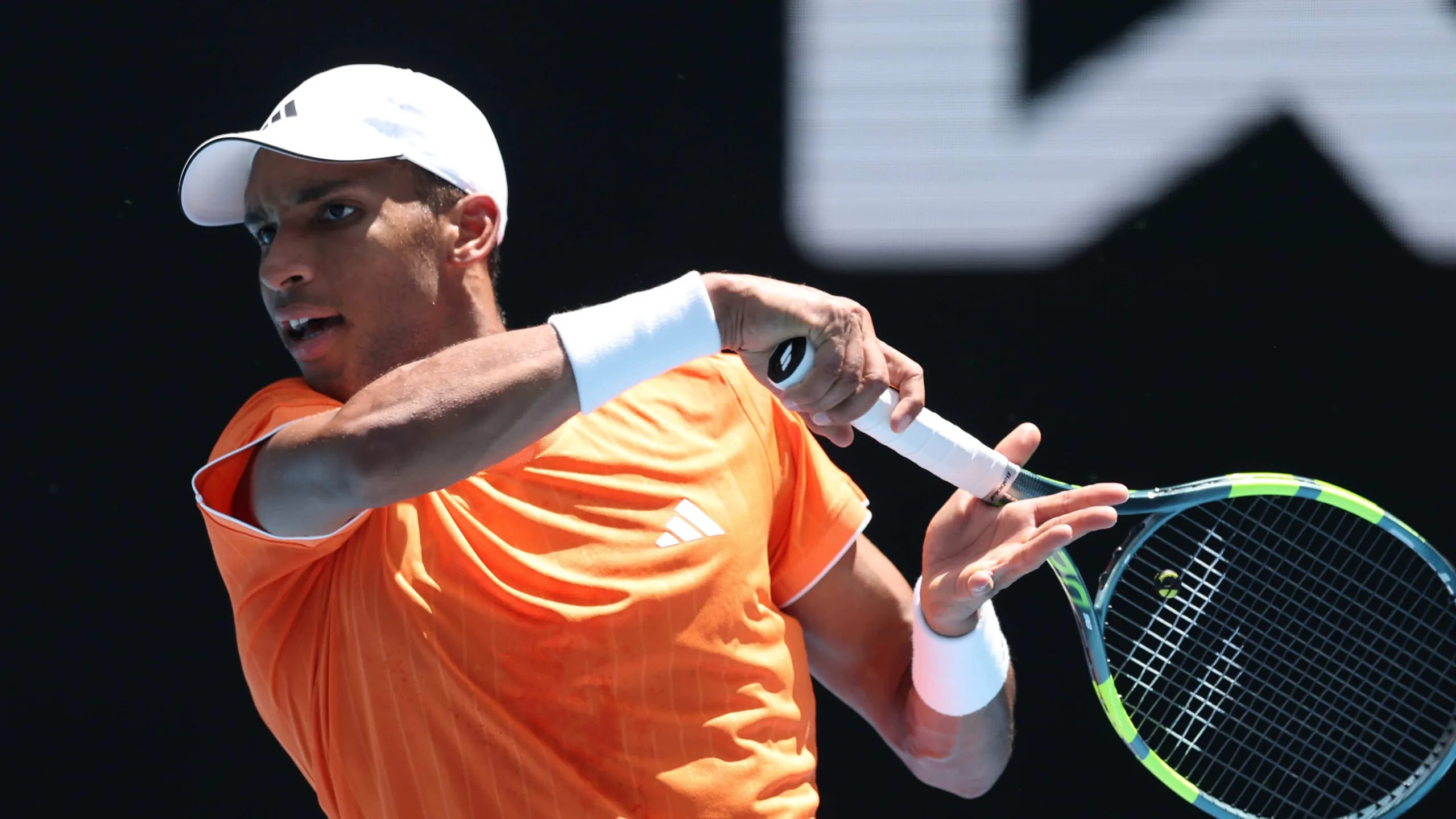
Felix Auger-Aliassime began his Miami Open campaign with a hard-fought straight-sets victory, defeating Marton Fucsovics 7-6 (3), 7-5 at the Masters 1000 event on Saturday afternoon. The 25-year-old Canadian secured the milestone in a match defined by small margins and timely serving.
The win marked the 200th hard-court triumph of Auger-Aliassime’s career, moving his record on the surface to 200-115. It is a notable landmark in his progression on the ATP Tour and places him among the leading players of his generation on hard courts.
Auger-Aliassime’s achievement also has generational significance. He is the second man born in the 2000s to reach 200 hard-court wins at tour level, following Jannik Sinner. Sinner sits at 241-54 on hard courts after his opening victory in Miami today, giving context to the elite company Auger-Aliassime joins.
Saturday’s match against Fucsovics was competitive throughout. A first-set tiebreak swung Auger-Aliassime’s way 7-3, and he closed the match in the second set with a late break to seal the 7-5 finish. The result provides a positive start to his run at a Masters 1000 tournament where winning early matches is often crucial to deeper progress.
The milestone underscores Auger-Aliassime’s consistency on the most common tour surface and highlights his capacity to win tight matches on big stages. As the Miami Open progresses, his form on hard courts will be watched closely by those tracking the season’s contenders.

Medvedev weathers travel woes to rally past Rei Sakamoto at Miami Open

Tommy Paul’s Camo, Collabs and the Quiet Work of Returning to Form

Auger-Aliassime notches 200th hard-court win in straight-sets Miami opener

Alcaraz Confronts On‑court Microphones During US Open Practice Ahead of Opelka Match

Raducanu Arrives at US Open With Momentum After Strong Hard‑Court Swing

Cervara: Ending an eight‑year partnership with Medvedev was necessary to change the energy
-
 ATPAustralian OpenGrand Slam2 months ago
Medvedev says he will not underestimate Learner Tien as their Australian Open rivalry resumes
-
 ATPAustralian OpenGrand Slam1 month ago
Offseason Focus: How Eliot Spizzirri’s Boca Raton block set up his Australian Open breakthrough
-
 ATPAustralian OpenGrand Slam2 months ago
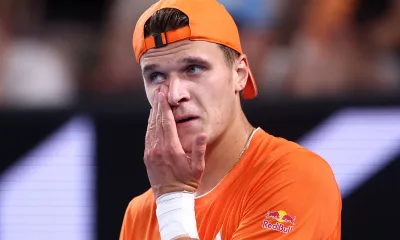
Jakub Mensik withdraws with abdominal injury, Novak Djokovic advances at Australian Open