
ATP Better Buzz Coffee San Diego Open Challenger Tour
Sebastian Korda returns to Challenger level in San Diego as he rebuilds after stop-and-go seasons
Korda returns to the Challenger level in San Diego, chasing match-day butterflies and form this week

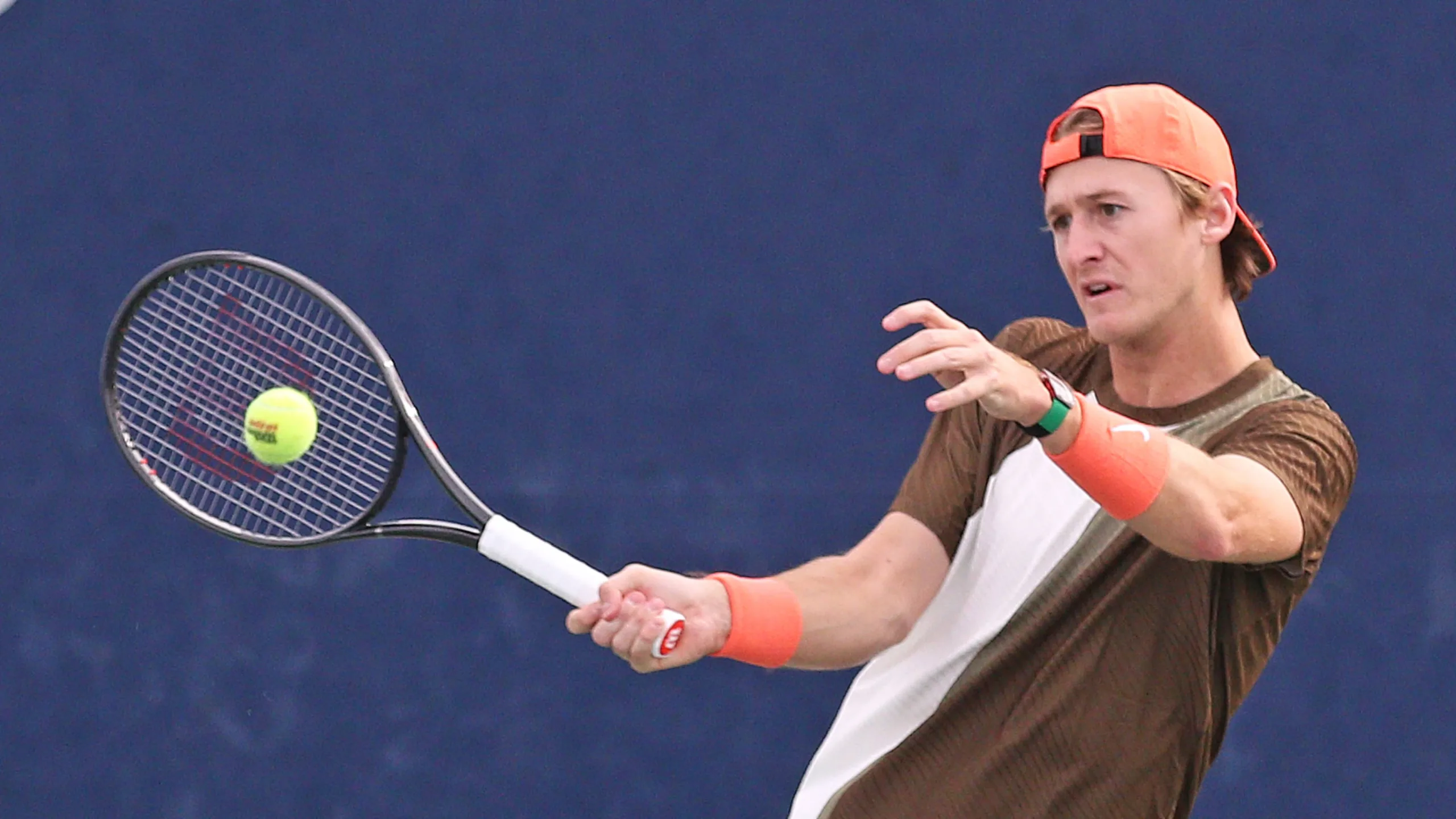
Sebastian Korda, a former world No. 15 who turned professional in 2018, has returned to the ATP Challenger scene for the first time in nearly five years at the 2026 Better Buzz Coffee San Diego Open. The week arrives as the Australian Open concludes and marks a notable point in a career often defined by starts, interruptions and comebacks.
When asked about his last Challenger, Korda answered plainly: “I lost in Biella to Dmitry Popko in two sets, I think. It was in 2021.” The San Diego week also coincides with the fifth anniversary of his Quimper Challenger victory, the result that launched his Top 100 debut. “I didn’t know this week was five years ago on the dot. That’s pretty cool,” he reflects.
Korda began 2026 strongly, reaching the Brisbane International quarterfinals, but returned from Australia frustrated by narrow defeats. He lost 7-6 in the third to Thanasi Kokkinakis in Adelaide, then fell in five sets to Michael Zheng at the Australian Open after rallying from two sets down. “Extremely disappointed with the whole Australian tour really,” he admits. “I thought it would be best to just stay in the competitive mindset. Luckily I got a wild card here in San Diego and I’m able to keep playing.”
On Wednesday at the Barnes Tennis Center, Korda, the top seed, opened with a 6-4, 7-5 victory over Daniel Milavsky. Before the interview he returned to the court to hit for 10 or so minutes, a departure from his usual routine but one he felt necessary.
Injuries have interrupted several seasons: a stress fracture in his right shin after Roland Garros in 2025 cost him nearly three months, a lower back issue flared at the US Open in his second event back, and right elbow surgery ended a previous season after New York. “It’s extremely difficult to kind of just stop and go, stop and go all the time. I think it definitely hurts you mentally. You just get in a really bad place when you’re injured and then you don’t really do too well when you’re coming back,” he shares. “You kind of lose that stressful feeling when you’re playing a tournament and that’s one of the things that I think I just need right now, especially with the amount of time that I missed. Just to keep playing the competitive environment and have those morning butterflies before a match.”
Asked a lighthearted final question about the upcoming Super Bowl, Korda said, “I think the Patriots are gonna win. Only because my best friend’s a Seahawks fan, so I gotta go against them.”


ATP Masters Miami Open
Tommy Paul’s Camo, Collabs and the Quiet Work of Returning to Form
Tommy Paul blends outdoor life, a New Balance collab and a patient return to top-level tennis. Now..

Tommy Paul has spent the early weeks of the season balancing a clear on-court mission with a life built around the outdoors and a pair of new shoes. “Being an outdoor kind of guy, I wear camo every single week if not every day,” Paul said, introducing the CT-Rally v2 “Outdoor Court” edition, his first colorway collaboration with New Balance.
“I think it’s the best-looking shoe on the market in tennis,” he said. Paul described New Balance as a partner that allows him style and expression. “They do what they want, and they do it well,” he told me. “They want to give me a platform to express myself and what I’m about.”
The apparel and equipment storyline sits alongside other outdoor projects. “It’s freedom, it’s meditation, but it’s also an escape,” Paul said of fishing and hunting. “Growing up in North Carolina, we’d be fishing every weekend I wasn’t playing in the summer. It was something I absolutely loved doing. I knew that, when I got older, I’d have that kind living where you go out there fishing, harvesting, and eating. It’s even cooler now because I’m in Florida and I can do it all year round.”
Paul also unveiled a partnership with Yellowfin Yachts, a new boat he enjoyed testing and joked about with peers. “That is so funny,” he said when I called it a “yacht.” He plans to travel in it, with the Bahamas on his short list.
The on-court narrative is straightforward. The 28-year-old former No. 8 halted his 2025 season after the US Open because of a foot injury that surfaced at Wimbledon, and he returned ranked No. 23. He pushed Carlos Alcaraz at the Australian Open, reached a final in Delray Beach and cites Davis Cup qualifying alongside Ethan Quinn and Emilio Nava as a season highlight. “I’m really just focused on right now, getting everything sorted and everything locked in to play my best tennis. If I’m playing my best tennis, everything will work itself out. I’m not really too focused on a No. 3 spot, Top 5 or Top 10 spot. I’m more focused getting to a point where I can play my brand of tennis consistently, without too much lapse. That’s what separates the top guys from the rest: even on their worst days, they figure out how to win a match. I think that’s something I’m really focused on.”
Off court, Paul has launched the Kids Outdoors Foundation with fiancée Paige Lorenze and worked with a Hobe Sound school. “They had a little basketball court, so we set up some tennis nets and spent some time with the kids, taught them a little tennis.”
ATP Masters Miami Open
Auger-Aliassime notches 200th hard-court win in straight-sets Miami opener
Felix Auger-Aliassime reached his 200th hard-court win with a 7-6(3), 7-5 victory in Miami. on Sat.
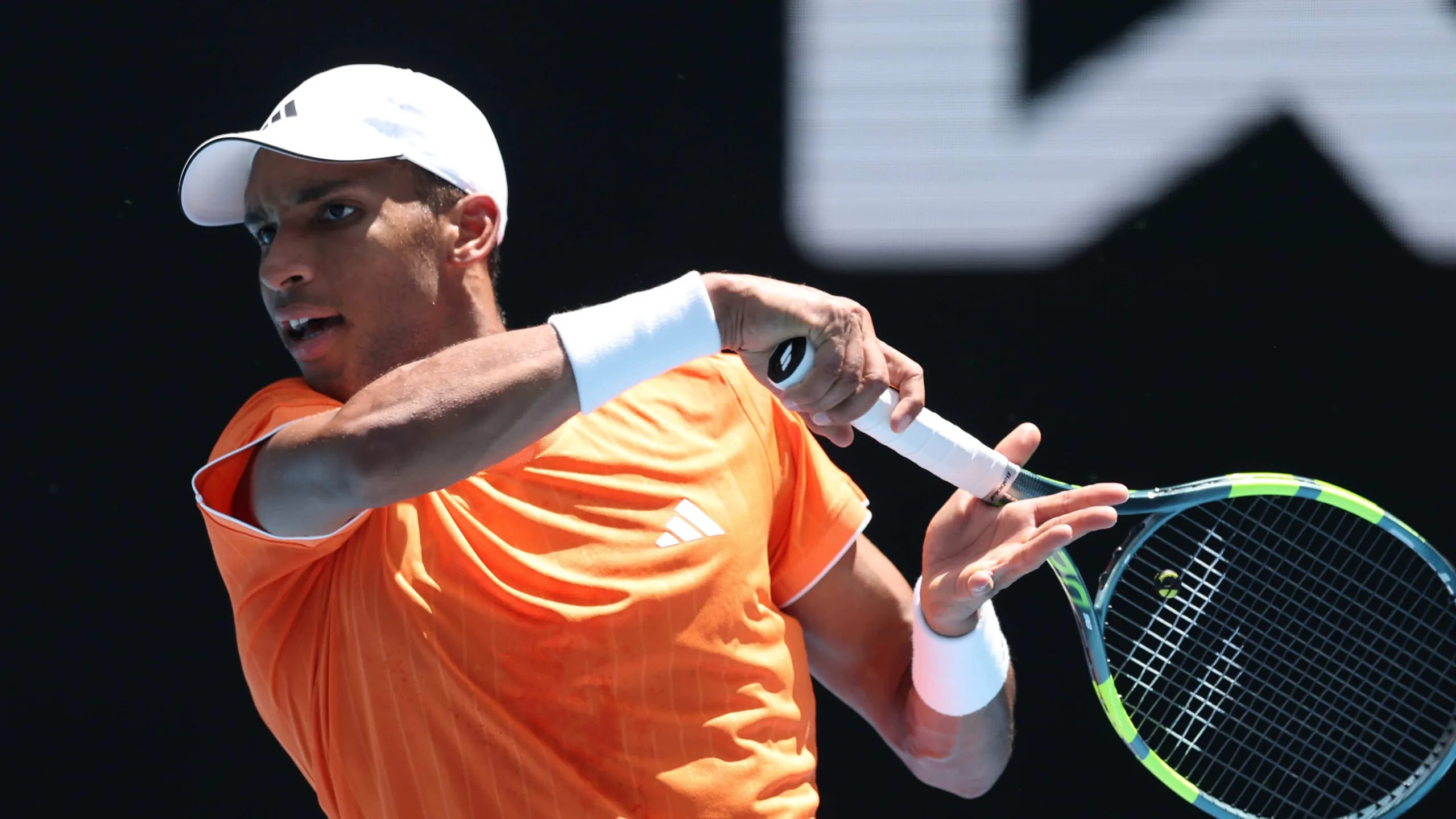
Felix Auger-Aliassime began his Miami Open campaign with a hard-fought straight-sets victory, defeating Marton Fucsovics 7-6 (3), 7-5 at the Masters 1000 event on Saturday afternoon. The 25-year-old Canadian secured the milestone in a match defined by small margins and timely serving.
The win marked the 200th hard-court triumph of Auger-Aliassime’s career, moving his record on the surface to 200-115. It is a notable landmark in his progression on the ATP Tour and places him among the leading players of his generation on hard courts.
Auger-Aliassime’s achievement also has generational significance. He is the second man born in the 2000s to reach 200 hard-court wins at tour level, following Jannik Sinner. Sinner sits at 241-54 on hard courts after his opening victory in Miami today, giving context to the elite company Auger-Aliassime joins.
Saturday’s match against Fucsovics was competitive throughout. A first-set tiebreak swung Auger-Aliassime’s way 7-3, and he closed the match in the second set with a late break to seal the 7-5 finish. The result provides a positive start to his run at a Masters 1000 tournament where winning early matches is often crucial to deeper progress.
The milestone underscores Auger-Aliassime’s consistency on the most common tour surface and highlights his capacity to win tight matches on big stages. As the Miami Open progresses, his form on hard courts will be watched closely by those tracking the season’s contenders.
ATP Masters Miami Open
Alcaraz Sees His Younger Self in Joao Fonseca After Miami Victory
Alcaraz said Fonseca reminds him of his younger self after a 6-4, 6-4 Miami win He praised the teen.
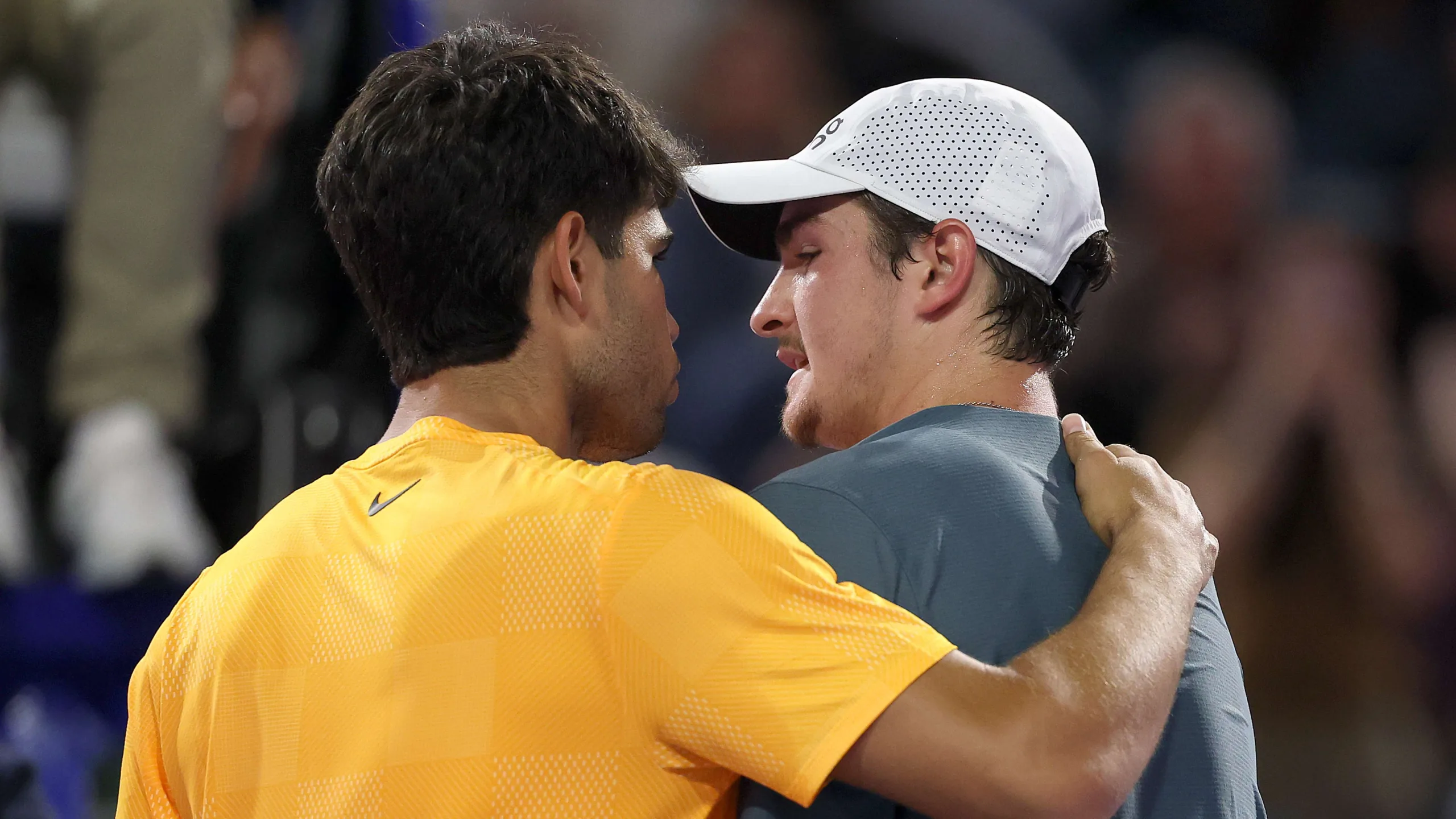
Joao Fonseca, the 19-year-old Brazilian, has now met the top two players on tour in the space of a month and on similar surfaces. He lost to Jannik Sinner at Indian Wells, 7-6, 7-6, and then fell to Carlos Alcaraz in Miami, 6-4, 6-4. Those results offered a clear lesson in the gulf that still separates a rising teenager from established champions.
Fonseca drew a sharp contrast between the two opponents he has faced. “I think Alcaraz has more arsenal than Sinner,” Fonseca said after his defeat at the Spaniard’s hands on Friday night. “Sinner is more like a robot that just kills the ball and does everything perfect.”
“Carlos, he can do everything. He can do with topspin, can fire the ball, he has good movement. Goes to the net. It’s more difficult to understand the game. He breaks a lot your rhythm.”
The match in Miami exposed particular vulnerabilities in Fonseca’s game. After a raucous welcome from the pro-Brazilian crowd, Fonseca started strong, but by the third game Alcaraz had already seized command. A sudden change in direction on a point forced Fonseca onto his slice backhand and opened a path for a return winner and an early break that Alcaraz would not relinquish.
Alcaraz’s margin was reflected in the match numbers. He finished with 27 winners to Fonseca’s 13 and made 70 percent of his first serves, winning 80 percent of those points. Those figures underline how difficult it is to beat Alcaraz when his serve and aggression are functioning.
Alcaraz offered his read on Fonseca after the match. “There were some times that he made a winner from behind the baseline with a fluffy ball that I just sliced, that I caught like a moonball, and from behind the baseline he was able to make a winner,” Alcaraz said. “It feels like he can make a winner every, you know, from everywhere. And that’s impressive.”
“He reminds me a lot when I was his age and just coming up,” Alcaraz said of Fonseca. “He should, I would say, he should choose the better option. Sometimes he misses a few shots or sometimes he miss like a lot of easy balls because he doesn’t choose the right shots, the right, you know, the right ball in certain situations.”
Fonseca left Miami with clear takeaways: the intensity required against Sinner and the unpredictability and shot selection required against Alcaraz. Those lessons will travel with him into the clay season.

Tommy Paul’s Camo, Collabs and the Quiet Work of Returning to Form

Auger-Aliassime notches 200th hard-court win in straight-sets Miami opener

Alcaraz Sees His Younger Self in Joao Fonseca After Miami Victory

Alcaraz Confronts On‑court Microphones During US Open Practice Ahead of Opelka Match

Raducanu Arrives at US Open With Momentum After Strong Hard‑Court Swing

Cervara: Ending an eight‑year partnership with Medvedev was necessary to change the energy
-
 ATPAustralian OpenGrand Slam2 months ago
Medvedev says he will not underestimate Learner Tien as their Australian Open rivalry resumes
-
 ATPAustralian OpenGrand Slam1 month ago
Offseason Focus: How Eliot Spizzirri’s Boca Raton block set up his Australian Open breakthrough
-
 ATPAustralian OpenGrand Slam2 months ago
Jakub Mensik withdraws with abdominal injury, Novak Djokovic advances at Australian Open